Imagine finding your dream plot of land, only to have the registration blocked at the last second because of a “Section 22A” flag. This legal provision is one of the most significant hurdles for property owners and buyers in Andhra Pradesh. However, with the 2026 “Year of Land Reforms” now in full swing, the state government has introduced massive changes to clear up historical errors and protect the rights of genuine owners.
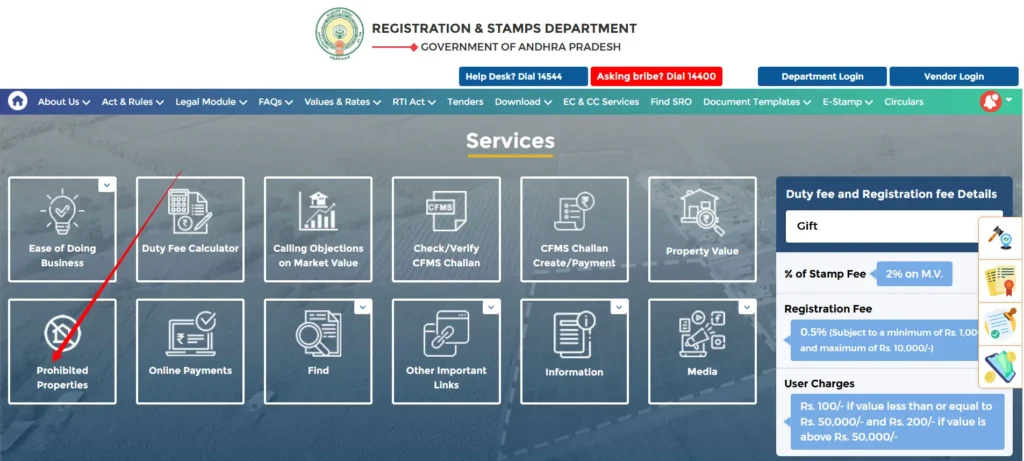
Understanding Section 22A of the Registration Act in Andhra Pradesh
Section 22A of the Registration Act, 1908, is an administrative tool that empowers the state government to stop the registration of properties that are “opposed to public policy”. The primary goal is to prevent the illegal transfer of government assets and lands meant for the poor.
The Five Main Categories of Prohibited Land
The law classifies prohibited lands into five specific clauses, each serving a different protective purpose.
- 22-A(1)(a) – Assigned Lands: This covers lands assigned to landless poor individuals for farming or housing. Under the 1977 Act, these lands generally cannot be sold or transferred.
- 22-A(1)(b) – Government Owned Lands: This includes all properties owned directly by the State or Central government. Private individuals are strictly barred from registering transactions on these plots.
- 22-A(1)(c) – Endowment and Wakf Properties: These are lands belonging to religious or charitable trusts and Wakf boards. Any sale or lease over 10 years is prohibited unless approved by a statutory authority.
- 22-A(1)(d) – Ceiling Surplus Lands: This targets lands declared as “surplus” under land reform acts, ensuring they are used for redistribution to the needy.
- 22-A(1)(e) – Notified Government Interest: This covers properties where the government has an “avowed or accrued interest,” such as those attached by courts. Crucially, for Clause (e) to apply, the government must issue a formal Gazette notification.
How to Check Prohibited Properties AP Online
In 2026, the digital ecosystem has made it easier than ever to perform due diligence before a property transaction.
Verification via the IGRS AP Portal
The IGRS AP portal is your first stop for checking registration status.
- Visit the official site at
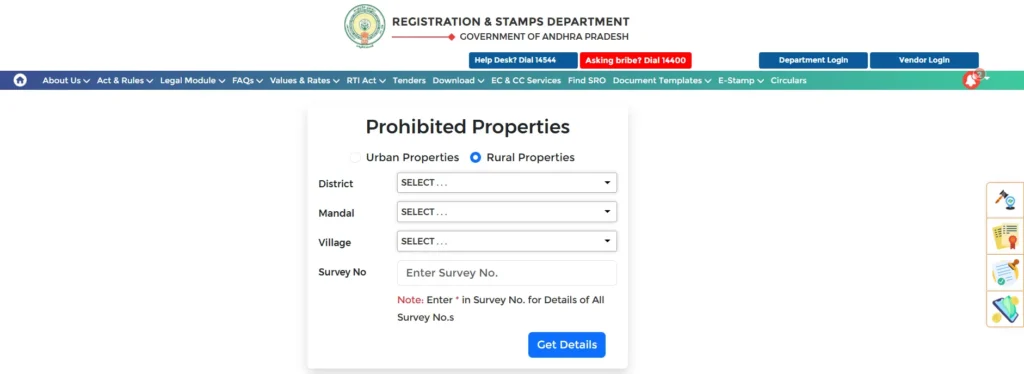
registration.ap.gov.in. - Select Prohibited Properties Search.
- Enter your District, Mandal, and Village.
- Input the Survey Number or Door Number to see if the property is blocked.
- If listed, the system will display the reason for prohibition and the notifying authority.
Cross-Checking with Meebhoomi AP
While IGRS shows the registration status, Meebhoomi provides the underlying revenue details.
- Adangal: This vital record shows land usage, soil type, and current possession.
- 1-B (Record of Rights): This document tracks ownership history and classification. By syncing these two portals, you can ensure that a property listed as “Private” on Meebhoomi isn’t accidentally caught on a “Government” list on IGRS.
The 2026 “Year of Land Reforms” Initiative
The state has officially declared 2026 as the “Bhumi Nama Samvatsaram”. Under the leadership of Chief Minister N. Chandrababu Naidu, the government is focusing on correcting widespread administrative errors that have frozen private titles for years.
5 Categories Removed from the Prohibited List
On January 1, 2026, the Revenue Department authorized the immediate deletion of five major categories from the 22A list:
- Defence Personnel Lands: Plots assigned to both serving and retired soldiers.
- Freedom Fighters Lands: Recognition of properties granted to national heroes.
- Political Sufferers/Victims: Lands granted as compensation for past social or political injustice.
- Pre-1954 Assignments: All genuine assignments made before June 18, 1954, as these original grants often lacked non-alienation clauses.
- Wrongly Included Private Patta Lands: Private titles mistakenly marked as government land due to data errors in the Webland system.
Mandatory Subdivision of Partially Disputed Survey Numbers
In the past, if just one acre of a massive survey number was disputed, the entire number was blocked. New 2026 guidelines now mandate that authorities subdivide the land. Only the specific disputed portion will remain on the prohibited list, while the undisputed private land is immediately freed for registration.
How to Remove Land from the 22A Prohibited List
The removal process has been streamlined to prevent the harassment of applicants.
Step 1: Gathering Sufficient Documentation
Landowners no longer need to submit a mountain of history. The government now accepts any one of these eight valid document types as proof for deletion:
- 10(1) Registers.
- Adangals or Pahani records.
- Settlement Fair Adangals (SFA).
- Old Assignment Registers.
- D-form (DKT) Pattas.
- Record of Holdings.
- Registered Registration Documents.
- 8-A Registers.
Step 2: Submission through MeeSeva or Revenue Conferences
You can apply for deletion through the MeeSeva system or at village-level “Revenue Conferences”.
- Timelines: Simple clerical errors on private lands are resolved in 15 to 45 days. More complex assignment reviews may take 1 to 3 months.
- The Collector’s Authority: The District Collector is the final competent authority for removing properties under clauses (a), (b), (d), and (e).
Socio-Economic Impact of 22A Inclusion
Being on the prohibited list isn’t just a legal headache—it’s a financial “credit freeze” for families.
- Blocked Registrations: Owners cannot sell, gift, or mortgage their properties.
- Loan Rejections: Banks strictly check the 22A list and will automatically reject any loan application where the land is listed.
- Market Value Drop: Listed properties are essentially “blacklisted,” leading to a massive drop in interest from buyers and a plummet in market value.
Role of the AP Lokayukta in Resolving Land Disputes
The Lokayukta of Andhra Pradesh is a powerful ally for citizens facing administrative corruption or land record tampering.
- Grievance Redressal: In 2024 alone, the Lokayukta received over 2,500 complaints, half of which were against the Revenue Department.
- Correcting Illegal Entries: Due to Lokayukta intervention, revenue authorities have corrected thousands of illegal or irregular land entries.
- Fund Recovery: The institution helped recover over Rs. 61 Crore in misappropriated public funds in 2024.
Frequently Asked Questions (FAQ)
Can I buy a prohibited property in AP? No. The registration system is programmed to automatically block any parcel marked under Section 22A.
How long does the 22A removal process take? Under the 2026 special drives, errors on private patta lands are usually fixed in 15-45 days, while assignment cases may take 1-3 months.
Is there a fee for checking the prohibited list? No. Checking property status on the official IGRS portal is completely free of cost.
What happens if a property is registered by mistake? Such registrations are generally considered illegal and can be annulled by the courts.
Do ex-servicemen lands have a lock-in period? Yes. Lands assigned to ex-servicemen or freedom fighters can only be sold after a 10-year period has elapsed from the date of assignment.
The 2026 land reforms, combined with new technologies like blockchain and AI, aim to make Andhra Pradesh’s land records immutable and secure. For landowners, this is a unique window to clear their titles and restore their full property rights.