Imagine finding your dream home in Visakhapatnam or a strategic plot in Vijayawada, only to discover later that it is tied up in a legal battle or an unpaid mortgage. In Andhra Pradesh, the Encumbrance Certificate (EC) is your ultimate shield against such nightmares. It serves as a financial and legal “report card” for any property, ensuring that your hard-earned investment is safe and the title is marketable.
Managing property in the digital age should be simple. The IGRS AP portal puts the power of verification in your hands, allowing you to trace a property’s history from your own home. Whether you are a first-time buyer or a seasoned investor, this guide will walk you through everything you need to know about the IGRS AP EC search.
What is IGRS AP EC?
The IGRS AP (Integrated Grievance Redressal System) is the official digital hub managed by the Registration and Stamps Department of Andhra Pradesh. It was created to bring transparency to property transactions and digitize a century-old legal framework.
Defining the Encumbrance Certificate (EC)
An Encumbrance Certificate (EC) is a legal document that provides a comprehensive history of every registered transaction for a specific property over a set period. An “encumbrance” refers to any liability, such as a mortgage, loan, or legal claim, that might affect the owner’s right to transfer the title.
The Role of the IGRS Portal in Property Governance
The portal uses the CARD (Computer-aided Administration of Registration Department) system to manage land records across all 26 districts of AP. It allows you to verify ownership, calculate stamp duty, and even book slots for physical registration at a Sub-Registrar Office (SRO).
Why You Need an Encumbrance Certificate in Andhra Pradesh
In Andhra Pradesh, property registration is the bedrock of ownership. Without a registered deed and a clear EC, your possession is legally precarious.
Confirming Absolute Legal Ownership
The EC validates that the person selling the property actually has the authority to transfer the title. It acts as a powerful shield against property fraud by providing a transparent notice of ownership history.
Mandatory Requirement for Home Loans and Mortgages
If you are applying for a home loan, banks will insist on a “Nil EC” (Form 16). This proves to the financial institution that the property is free from prior debts and can be used as secure collateral.
Updating Land Records and Mutation (Meebhoomi)
After buying property, you must update the title in revenue records like Meebhoomi or Adangal. This process, called Mutation, requires an EC to ensure tax assessments are correctly issued in your name.
Step-by-Step: How to Conduct an IGRS AP EC Search Online
Searching for your property’s digital footprint is fast and efficient. However, you must keep in mind the 1983 Digital Threshold: online records are generally only available for transactions made after January 1, 1983.
Search by Document Number or Memo Number
- Visit the official site:
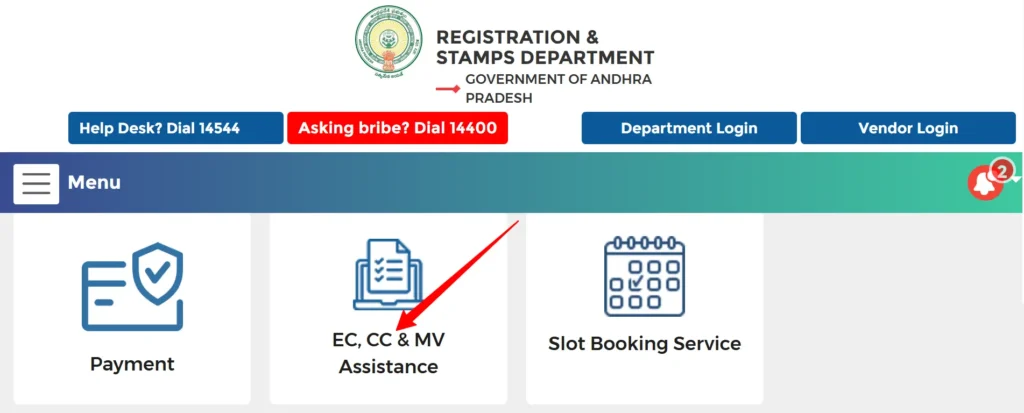
registration.ap.gov.in. - Click on “EC Search” or “EC, CC & MV Assistance”.
- Log in with your User ID and Password (register as a new member if needed).
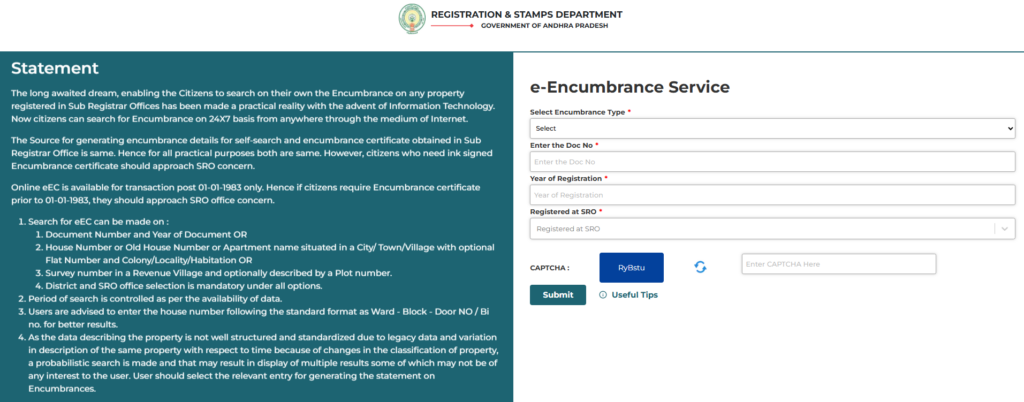
- Choose the search criteria: Document Number.
- Enter the Document Number and registration year.
- Select your District and the specific Sub-Registrar Office (SRO).
- Enter the captcha and hit Submit.
Search by Survey Number or Property Address (The “None” Option)
If you don’t have the document number, don’t worry. You can use the “None” option for a probabilistic search.
- Provide the mandatory District, Mandal, and Village details.
- Enter the Survey Number or Plot Number.
- For urban properties, provide building details like the Flat Number or Apartment Name.
- Select the search period (e.g., the last 30 years).
Tips for Urban Property Search
When searching for urban properties, enter the address in the standard Ward – Block – Door No. format for the most accurate results.
Understanding Types of EC: Form 15 vs. Form 16
The IGRS system issues two distinct forms based on what the records show.
Form 15: Encumbered EC (Active Financial Liabilities)
Form 15 is issued if the property has registered transactions during the search period. This document will list every sale, gift, lease, or mortgage entry that needs to be scrutinized by a legal expert.
Form 16: Nil Encumbrance Certificate (The “Clear” Report Card)
Also known as a NIL EC, Form 16 confirms that no transactions have occurred for that property during the requested time. This is the “clean bill of health” banks look for when processing loans.
Signed vs. Unsigned EC: Which One Do You Need?
The portal offers two versions of the certificate depending on your goal.
Unsigned EC for Preliminary Information
The “EC for Information Only” is free and requires no login. It is perfect for initial due diligence, but it holds no legal weight in court or for banking purposes.
Digitally Signed EC for Legal and Banking Purposes
A Digitally Signed EC is the official version. It requires a nominal fee and login credentials, but it is legally valid for loans, court evidence, and government approvals.
Fees, Processing Time, and Records Limitations
The cost of an EC is intentionally nominal to ensure affordability for all citizens.
| Search Duration | Applicable Fee |
|---|---|
| Up to 30 Years | Rs. 200 |
| Beyond 30 Years | Rs. 500 |
| Online Service Charge | Rs. 25 |
Processing Time
Online ECs are often available instantly or within 24 hours. If you apply offline at an SRO, it typically takes 7 to 15 working days.
Troubleshooting Common IGRS AP EC Search Issues
Even the best systems have hiccups. Here is how to handle common problems:
- “No Results Found”: Double-check the document number or try a Survey Number search.
- Digital Signature Verification: If the PDF says “signature not verified,” open it in Adobe Acrobat and configure your trust settings for government certificates.
- Data Accuracy: If you spot a boundary error (e.g., North and South being identical), you must visit the SRO for a rectification deed.
Fraud Prevention: The IGRS AP Prohibited Properties List
Before you ever sign a contract, check the Prohibited Property Search on the portal. Under Section 22-A of the Registration Act, certain lands cannot be sold, including government land, endowment land, or properties under court dispute. If a property is on this list, the SRO is legally barred from registering any deed for it.
Frequently Asked Questions about IGRS AP EC
Can an EC serve as proof of property ownership?
No. The EC only shows transactions and liabilities. Ownership is proven through the Sale Deed or Patta.
How long is an AP EC valid?
It remains valid until the next transaction occurs on the property. However, for home loans, banks usually require an EC issued within the last 3 months.
What if I need records before 1983?
You must visit the respective Sub-Registrar Office (SRO) for a manual search of physical registers.
Conclusion: Securing your property investment in Andhra Pradesh starts with a simple IGRS AP EC search. By following these steps and checking both the EC and the Prohibited Properties list, you can move forward with absolute peace of mind. Don’t skip this 10-minute check—it could save you from years of legal stress.